
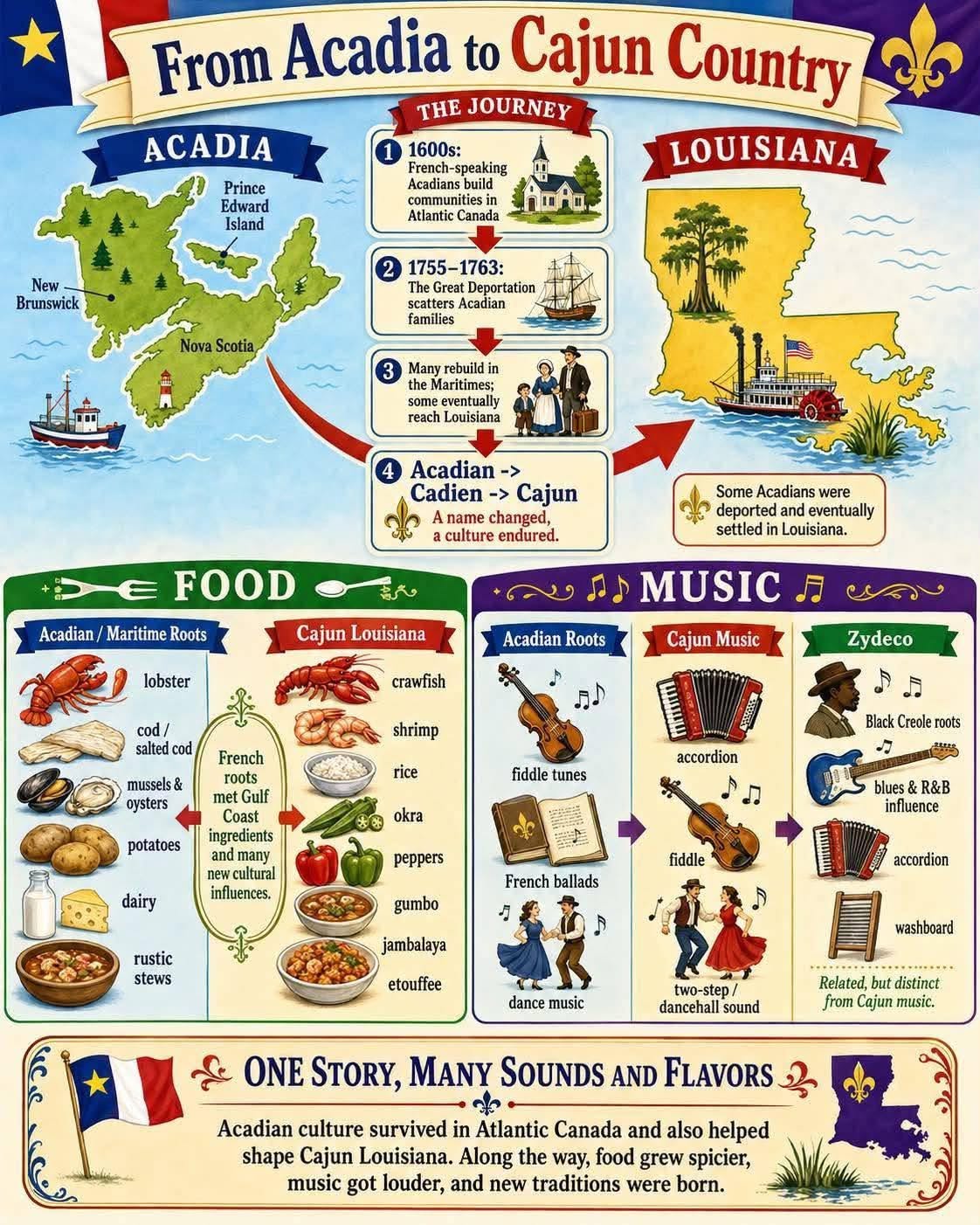
I’ve spent the last few days driving through old Acadia — Nova Scotia, New Brunswick and now Prince Edward Island — and one of the coolest things has been realizing how much of Louisiana started right here.
The Acadians were French-speaking settlers who built communities throughout this part of Atlantic Canada beginning in the 1600s. Then, in 1755, the British began the Great Deportation, scattering thousands of Acadians across North America and Europe.
Some eventually found their way to Louisiana.
Over time, “Acadian” became “Cadien,” and then Cajun.
Suddenly a lot of things I’ve experienced in Louisiana make more sense.
The food evolved dramatically after the Acadians reached the Gulf Coast. Cold-water fish, dairy and Maritime ingredients gave way to rice, crawfish, shrimp, oysters, pork, peppers and okra. French techniques mixed with African, Spanish, Caribbean and Native American influences, creating something completely new: gumbo, jambalaya, étouffée, boudin and the rest of Cajun cooking.
The music followed a similar path.
Traditional Acadian fiddle music traveled south, where it mixed with other Louisiana sounds. Cajun music developed one direction, while Black Creole musicians created zydeco, blending French Creole traditions with blues, R&B and African-Caribbean rhythms. Accordion, fiddle and washboard became part of a musical family tree whose roots stretch all the way back up here.
And the Acadians themselves didn’t disappear from Canada.
Their culture is still very much alive in New Brunswick, Nova Scotia and PEI — French-speaking communities, Acadian flags, food, music and family names that survived despite an attempt to scatter them permanently.
So this part of my Canada trip has turned into more than just lobster, lighthouses and ridiculously high tides.
I’ve essentially been traveling through the ancestral homeland of Cajun culture.
It’s pretty amazing to stand in Acadia and realize that somewhere down the historical road from here are crawfish boils, accordions, zydeco clubs and a pot of gumbo simmering in Louisiana.
History travels.
And apparently, it gets considerably spicier along the way.
Bill Wiatrak